




Johann Sebastian Bach
Concerto Transcriptions for Solo Piano
 back
back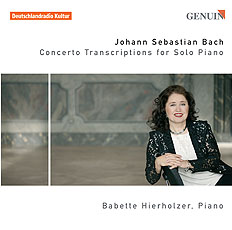
GEN 87088 EAN: 4260036250886
27.4.2007
Special offer18.90 € 16.90 €
The subject of keys is unavoidable for anyone who concerns himself with Johann Sebastian Bach. It does not matter if most of them are white, as with the modern piano, or black, as with many harpsichords. It makes no difference if they bring a variety of strings to life by means of a complicated hammer mechanism or breathe into hundreds of pipes through kilometre-long tubes. The musical patriarch of Leipzig was a “key man,” regardless of how much he enjoyed playing the viola here and there or singing with his numerous children. He composed for the harpsichord and improvised on the organ; arranged and transcribed, exploiting the possibilities of the instruments of his time to the utmost and … who knows? If he had had a modern concert grand at his disposal – maybe it would have sounded just like the one on the new GENUIN CD! The days of ideological trench-warfare between the defenders of historical performance practice and “traditional” music-making are fortunately over. Pianist Babette Hierholzer plays a colourful, luminous and swinging Bach – as if the old master had just handed it to her before the ink was dry.
"Her playing has this wonderful crystalline transparency which is hard and feather-light at the same time, revelling in bliss; at the same time, not one note is lacking in interpretative power."
Piano News 4/2007
Audio Player
Tracklist
- Johann Sebastian Bach (1685-1750)
Concerto No. 3 in D Minor BWV 974
Based on an oboe concerto by Alessandro Marcello - Johann Sebastian Bach
Concerto in D major BWV 1054
Based on the violin concerto in E Major - Johann Sebastian Bach
Concerto No. 4 in G Minor BWV 975
Based on an violin concerto by Antonio Vivaldi - Johann Sebastian Bach
Concerto No. 14 in G Minor BWV 985
Based on a violin concerto by Georg Philipp Telemann - Johann Sebastian Bach
Concerto No. 6 in C Major BWV 977
Source unknown - Johann Sebastian Bach
Concerto No. 7 in F Major BWV 978
Based on the violin concerto by Antonio Vivaldi, op. 3 No. 3 - Johann Sebastian Bach
Italian Concerto in F Major BWV 971
The subject of keys is unavoidable for anyone who concerns himself with Johann Sebastian Bach. It does not matter if most of them are white, as with the modern piano, or black, as with many harpsichords. It makes no difference if they bring a variety of strings to life by means of a complicated hammer mechanism or breathe into hundreds of pipes through kilometre-long tubes. The musical patriarch of Leipzig was a “key man,” regardless of how much he enjoyed playing the viola here and there or singing with his numerous children. He composed for the harpsichord and improvised on the organ; arranged and transcribed, exploiting the possibilities of the instruments of his time to the utmost and … who knows? If he had had a modern concert grand at his disposal – maybe it would have sounded just like the one on the new GENUIN CD! The days of ideological trench-warfare between the defenders of historical performance practice and “traditional” music-making are fortunately over. Pianist Babette Hierholzer plays a colourful, luminous and swinging Bach – as if the old master had just handed it to her before the ink was dry.
"Her playing has this wonderful crystalline transparency which is hard and feather-light at the same time, revelling in bliss; at the same time, not one note is lacking in interpretative power."
Piano News 4/2007